
Home inventory for renters: a 30-minute setup
Renters skip home inventories more than homeowners — partly because the move is recent and possessions feel "in transit", partly because renters' insurance feels optional. Both reasons are common, and both are mistakes. There are three concrete situations where a half-hour of work as a renter pays off massively. Here they are, and here's how to do the work.
The three battles renters lose for lack of proof
Battle 1: Filing a renters insurance claim
Average renter's insurance policy: $15-$25 per month. Average claim payout when proof is complete: $4,000-$15,000 (theft, fire, water damage). Average claim payout when proof is missing: a fraction of replacement cost, weeks of back-and-forth, sometimes outright denial.
Insurers settle quickly when they can verify what was lost and what it was worth. Without receipts and photos, they have to rely on what you can recall — and you'll forget about half of what was in the apartment under stress.
Battle 2: Security deposit disputes
The single most common landlord deduction: "damage" to items that were already worn or stained when you moved in. The single best counter-evidence: dated photos of the apartment condition on day 1, with receipts for any items you brought in (and therefore can take with you).
If your deposit is $1,500 and the landlord deducts $400 for "carpet replacement", proving the stain was there in your move-in photos saves you that $400. If you have no photos, you have no leverage.
Battle 3: Liability or chargeback disputes
Bought a $2,400 dishwasher for a rental? Whose is it? Did your landlord install it, or did you? When the lease ends — or worse, when something breaks and water damages the floor below — having the original receipt with your name on it is the difference between a refund and a fight.
The 30-minute setup
Block 30 minutes. Walk through your home with your iPhone. For every item worth more than ~$100:
- Photograph it in its current location (front, back, model plate)
- Find the receipt. Email search for the store name. Most online purchases since 2018 are in your inbox.
- Note the room (kitchen, bedroom, etc.) — useful when you eventually file a claim by area
- Estimate the value if you can't find an exact receipt
Don't try to be exhaustive on day 1. Capture the obvious: laptops, TVs, kitchen appliances, jewelry, watches, bikes, musical instruments, expensive furniture. Anything you'd cry over if it disappeared.
What to do when you can't find a receipt
For older items, a credit card statement showing the purchase amount on the right date is acceptable to most insurers. Here's the order of fallback proof:
- Original receipt (paper or email PDF)
- Credit card / bank statement
- Photo of the item with a date stamp + recent comparable price
- Manufacturer registration confirmation
- Box, instruction manual, or warranty card
The move-in routine
If you're moving into a new rental, do this before you unpack:
- Walk every room with your phone, video on. Open every cabinet, every drawer.
- Photograph every wall, every appliance, every floor surface.
- Time-stamp these by uploading them to iCloud or emailing them to yourself the same day.
- Save the move-in inspection PDF (the landlord's checklist), with your countersignature.
If a deposit dispute happens 18 months later, this 20-minute walkthrough decides the outcome.
Renters who walk through their apartment with a camera on day 1 win 80% of deposit disputes. Renters who don't, win less than 20%.
How HomeProof helps
HomeProof is built for exactly this workflow:
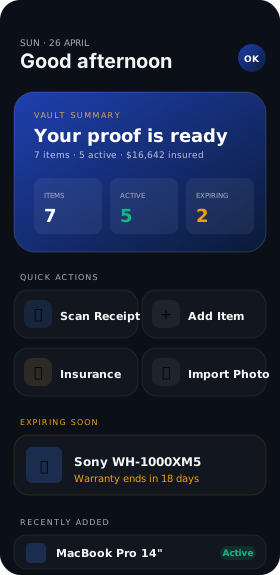
- Capture fast. Tap +, scan a receipt, attach a photo, set a category. 30 seconds per item.
- Search later. Filter by Electronics, Appliances, Furniture. Full-text search by item name, brand, or serial.
- Generate the inventory PDF. One tap. Owner block, total value, item-by-item table, photos. Send it to your insurer or store it in your iCloud Drive.
- Stay private. Data lives on your iPhone (and your iCloud). Not on a HomeProof server. Not in someone's analytics pipeline.
Free for up to 20 items, $19.99/year for unlimited and insurance reports. For the cost of a single Friday lunch, you've documented every item you'll ever need to prove you owned.
Build your renter inventory in 30 minutes
HomeProof on iPhone — free for your first 20 items.
Download on theApp Store